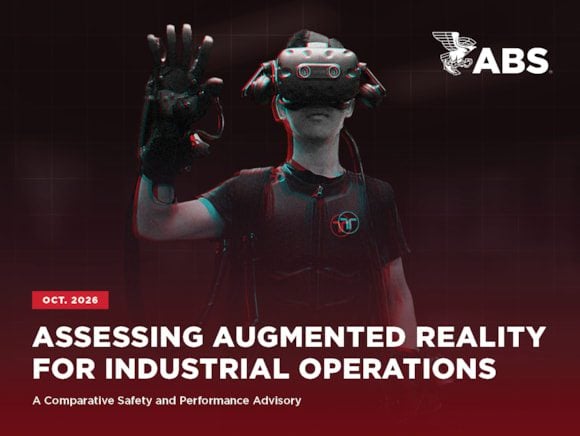
ABS has published guidance to help marine and offshore operators assess whether augmented reality (AR) can improve crew performance without weakening safety, gCaptain reported. The publication sets out an approach for testing the technology against established working methods, with potential applications ranging from equipment inspection and maintenance to navigation, training and assistance from remote experts.
The ABS Advisory on Assessing Augmented Reality for Industrial Operations focuses on evaluating both safety and performance rather than assuming that digital support will deliver benefits in every setting. According to gCaptain, ABS sees scope for AR to make industrial tasks more efficient and consistent, but says wider adoption depends on showing that productivity improvements do not come at the expense of safe operations.
The technology allows workers to see operational information within their normal field of view. Possible uses include presenting a technician with a sequence of instructions, identifying inspection locations and equipment tolerances, and indicating hazardous areas or spaces where access is restricted. The value of those functions will vary with the work being undertaken, the person using the system and conditions in the operating environment.
Developed with support from the ABS Laboratory for Ocean Innovation at Texas A&M University, the advisory describes a structured comparison of AR-assisted work and baseline practices. It distinguishes between tasks requiring navigation, coordination between sight and movement, recall, or processing of information. Those differing demands mean assessments need to address the particular activity the technology is intended to support. The guidance also examines potential drawbacks, including distraction, obstruction of the user’s view and excessive dependence on system-generated information.
Patrick Ryan, ABS senior vice president and chief technology officer, said the potential to bring expert advice, operational information and digital procedures directly to workers required a rigorous understanding of the consequences for safety and performance. As applications progress beyond trials into routine operations, ABS said it would continue collaborating with industry on safe technology adoption, gCaptain reported.